
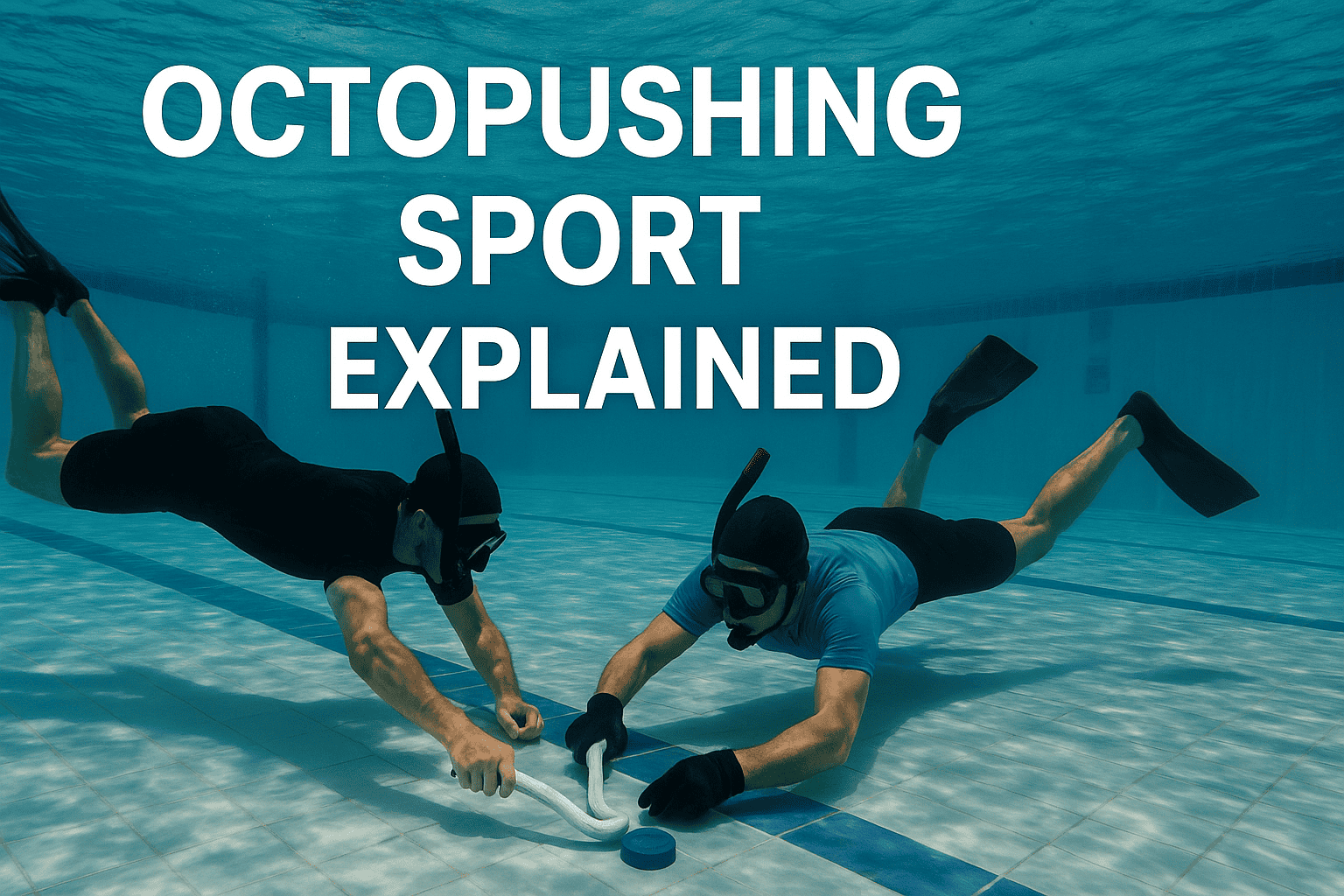

Octopushing Sport (also called Octopush or underwater hockey) is an exciting aquatic team sport where players in snorkel gear push a weighted puck along the bottom of a pool into the opposing goal. This dynamic game blends elements of hockey and freediving, demanding breath-control, speed, and teamwork. Originating as a training activity for divers, Octopushing Sport has grown into a competitive international sport enjoyed by thousands worldwide. In this article, we dive deep into the history, rules, equipment, and interesting facts about Octopushing Sport, explaining everything you need to know about this unique water-based game.
Image: Two Octopushing Sport players wearing masks, snorkels, and fins compete for the puck underwater (Underwater hockey match).
What Is Octopushing Sport? Often referred to as Octopush or underwater hockey, Octopushing Sport is played in a swimming pool on the bottom rather than on ice or land. Two teams swim along the pool floor, each using a small curved stick (called a pusher) to move a lead-filled puck toward the opponent’s goal. Players must hold their breath underwater – no scuba gear is allowed – surfacing frequently to breathe between dives. The sport’s name “Octopush” comes from its original format of eight-player teams (“octo-”) using a stick to push the puck.
Over time, official team size shifted to six players in play per side, but the nickname remains. Octopushing Sport is a limited-contact game: only sticks can touch the puck, and players cannot interfere with opponents using their free hand.
summery
History of Octopushing Sport
- Origins (1954): Octopushing Sport was invented in 1954 by British diver Alan Blake of the Southsea Sub-Aqua Club in Portsmouth, England. Blake created the game (initially called Octopush) as winter training for divers, keeping club members active when diving in open water was not possible. The first sets of rules were tested in late 1954 with small pool demonstrations.
- Early Competitions (1955): The first Octopush tournament took place in early 1955 in the UK, with teams from Southsea, Bournemouth, and Brighton competing. Southsea won that first championship, and the sport spread quickly.
- International Spread (1950s–1970s): By the late 1950s, Octopushing had reached Durban, South Africa, where a local dive club organized regular pool games. In the 1960s, the game crossed the Atlantic via Norm Leibeck, an Australian diving instructor: he brought Octopushing to a Vancouver dive club in 1962 and later to Australia in 1966. The first Australian national championship was held in 1975, with a women’s division added in 1981. The Philippines adopted the sport in the late 1970s.
- Governance and World Championships: The international governing body is CMAS (Confédération Mondiale des Activités Subaquatiques). Under CMAS, the first Underwater Hockey World Championship (Octopush World Championship) was held in Canada in 1980. Since then, world championships have been held biennially, drawing teams from around the globe. For example, the 2013 World Championship featured 68 teams from 19 countries, illustrating the sport’s growth. Octopushing is not an Olympic or Paralympic sport, but it is recognized in the World Games.
Key Historical Milestones:
- 1954 – Octopush invented by Alan Blake (Portsmouth, UK).
- 1955 – First club tournament (Southsea, Bournemouth, Brighton).
- 1957 – Spread to South Africa, weekly pool contests begin.
- 1962 – Introduced in Canada (Vancouver dive club).
- 1966 – Arrives in Australia; national championships by 1975.
- 1980 – Inaugural Underwater Hockey World Championship (Canada).
- 2013 – 68 teams from 19 nations compete in World Championship.
These developments show how Octopushing Sport evolved from a local training game into a structured international competition (sometimes still called Octopush). The name reflected the original eight-player format and the small “pusher” stick. Today, official matches use 6 players per side in the water, but clubs and informal games can vary team sizes.
Rules and Gameplay
Octopushing Sport follows clear rules to ensure fair play while emphasizing safety and stamina. Key rules include team size, equipment requirements, match structure, and conduct:
- Teams and Players: Each team consists of up to 10 players, with 6 players in the water at any time and 4 substitutes. Teams often organize into forwards (offense) and backs (defense) – typically in a 3-3 formation (three forward, three back) – but formations are flexible. Substitutions are rolling: players surface to breathe and switch with a teammate continuously during play. No more than 6 players per side may be in the play area simultaneously (excess players result in a penalty).
- Equipment: Players must wear a diving mask (full face coverage for vision), snorkel, and swim fins for mobility. They carry a short stick or “pusher” (around 30 cm long) in one hand to move the puck. Additional gear includes a water-polo cap with ear protectors and protective gloves (and often an exterior mouthguard). The puck is a flat, weighted disc, typically coated in plastic to slide along the pool bottom without bouncing. All listed equipment is mandatory for safety and play.
- Playing Area: Matches take place in a swimming pool (usually 15–25 meters long and 2–4 meters deep). Each end of the pool has a goal (similar to a hockey goal, lying on the bottom). Before play starts, the puck is placed at the pool’s center line. Players line up against the wall at their respective goal ends.
- Match Start and Flow: At the starting signal (buzzer or whistle), players swim to the puck and begin play. Only the stick may touch the puck; players cannot use their free hand to push or carry it. As soon as the game starts, players alternate diving and surfacing. When underwater, a player holds their breath (a form of dynamic apnea) as they push, pass, or shoot the puck. When they surface, they breathe normally and often tag in a teammate. This rapid cycling keeps all 6 players on each side active throughout the 2×15-minute game.
- Scoring: The objective is to maneuver the puck into the opponent’s goal. Each goal scored (puck fully crossing the goal line) earns one point. After a goal or any stoppage (e.g. a foul or offside), play restarts from the defending team’s wall. The team with the most goals at the end of regulation (two 15-minute halves with a 3-minute halftime) wins the match. In ties, many competitions allow overtime or shootouts.
- Breath-Control Rule: A unique rule in Octopushing is no scuba or external air supply. Players must hold their breath whenever submerged. This rule makes Octopush a demanding fitness challenge: players alternate brief underwater bursts (often 10–20 seconds each) with surface breathing. Notably, a recent study found that Octopush players’ average dive time with the puck is only about 12 seconds, dispelling the idea that it’s an extreme freediving sport.
- Fouls and Safety: Because players are equipped with fins and gloves, Octopushing is officially a limited-contact sport. Illegal actions include using the hands (or swimming legs) to push the puck, striking opponents (especially in the head), or obstructing a player’s path. Minor fouls typically result in a positional turnover (advantage rule), while major fouls can lead to player ejections. Safety gear (ears and gloves) helps prevent injury on the pool bottom.
Equipment Checklist:
The following items are essential for Octopushing Sport:
- Diving mask and snorkel for vision and breathing at the surface.
- Fins (swim fins) to propel underwater.
- Short stick (pusher): a small, curved underwater hockey stick.
- Weighted puck: a lead-containing disk that stays on the pool floor.
- Protective glove: worn on one hand to shield against the hard bottom.
- Water polo cap with ear guards: protects ears and identifies team.
- Exterior mouth guard: often worn on snorkel for extra dental safety.
Maintaining this gear and using it correctly is vital. For example, the snorkel lets players keep their head submerged while breathing, so they can stay ready to re-enter play immediately. All equipment must conform to regulations (e.g. fins without buckles or sharp parts) to ensure safety and fairness.
Gameplay Examples and Strategies
Octopushing Sport’s fast pace leads to some distinctive gameplay patterns:
- Game Start: The puck is placed at center, players touch their goal-end wall. When the buzzer sounds, all players race toward the center to gain possession.
- Rotation: Because players cannot stay underwater long, teams typically use six-player bursts. For example, 6 players dive, play for ~10–15 seconds, then surface simultaneously. The 4 substitutes (or rotating players) are ready to dive in sequence, ensuring fresh legs. This “leapfrog” style keeps the game continuous.
- Passing and Teamwork: While underwater, communication is mostly through hand signals and pre-arranged plays, since talking is impossible. Teams practice passing the puck quickly between divers. Forwards (attackers) focus on moving the puck forward, while backs try to block shots and retrieve turnovers.
- Defense: When out of breath or beaten to a puck, players must surface safely. A common strategy is to have three forwards pressing deep and three defenders splitting in front of the goal (similar to ice hockey positions). Quick slides and fin-kicks are used to block opponents and to intercept the puck without resorting to contact.
- Re-Entry: After surfacing, a player tagged in a substitution flies from the wall back down to the play, often by doing a dive-roll and kicking off the bottom for momentum. Teams train to minimize the lag time off-surface.
Image: A team preparing for an Octopushing Sport (underwater hockey) match at a pool. Players are wearing snorkels, caps, and fins on the surface before diving in.
These tactics make Octopushing Sport a thrilling team-oriented underwater battle. It requires not only swimming skill and breath-hold ability, but also split-second decision-making. The interplay of passes at the bottom and lunges for the puck – all while racing the clock on air – gives the sport its unique excitement.
Competitions and Global Popularity
Octopushing Sport is organized in leagues and tournaments worldwide. Although still a niche sport, it boasts a global community:
- International Championships: World Championships occur roughly every two years under CMAS (though in recent years, governance split led to an alternate World Aquachallenge Association series). Teams compete in men’s, women’s, and age-group categories. European Championships and regional events (e.g. Southeast Asian Games, Celtic Cup) also feature underwater hockey.
- Countries and Clubs: Major Octopushing communities exist in the UK (where it all began), South Africa, Australia, New Zealand, Canada, and Europe (France, the Netherlands, etc.). Asia (especially the Philippines, Japan, and Singapore) has growing participation. As of 2013, teams from 19 countries entered the World Championship. Today, dozens of national clubs send teams to international events.
- Governing Body: The CMAS governs official rules and competitions for underwater hockey. National scuba or sub-aqua clubs often have Octopush sections. The World Games include underwater hockey, giving it broader exposure.
- Non-Olympic Sport: Underwater hockey (Octopush) is not in the Olympics or Paralympics. However, its inclusion in multisport events like the World Games highlights its athletic legitimacy.
In competitive play, teams often wear matching caps and colored dive gear. Because visibility underwater is limited, bright pucks (usually pink or orange) are used. Matches are usually officiated by referees on the pool deck with submarines watches and whistles, assisted by underwater referees who follow play on the pool bottom.
Interesting Facts
- Name Origin: The original UK name “Octopush” comes from octo- (eight, as teams of 8) + push (the stick action). Now that teams use 6 players in play, the name is kept for tradition.
- Breath Holding: Contrary to myths, research shows Octopush players breathe very frequently – averaging only about 10–12 seconds underwater per breath. This is far below the threshold of an “extreme apnoea” sport. Nonetheless, efficient breath management is key.
- Equipment Evolution: Early Octopush used a flat lead puck called a “squid” and wooden pushers. Modern gear uses plastic-coated pucks and high-tech sticks, fins, and masks, making the game faster.
- Player Fitness: Successful players are typically strong swimmers with good lung capacity and agility. It’s also common for water polo players, competitive swimmers, and freedivers to excel in Octopushing because of their aquatic skills.
- Scoring Prowess: A high-scoring game might see teams combine for 8–15 goals in a match, but defensive battles can also be low-scoring. Speed of play and quick passing can lead to sudden scoring bursts.
- Team Size Variants: While 6-per-side is standard, some local or exhibition games use 4-per-side or 8-per-side with adjusted rules.
- Notable Clubs: The Southsea Sub-Aqua Club (UK) is often cited as the birthplace club of Octopush. Other historic clubs include the Durban Undersea Club (South Africa) and various Australian dive clubs.
Getting Started and Equipment
If you’re interested in trying Octopushing Sport, here are some practical tips:
- Local Clubs: Search for underwater hockey or scuba clubs in your area. Many swimming pools offer beginner sessions. Clubs typically provide loaner gear (mask, snorkel, fins, glove, stick).
- Equipment: To play regularly, you’ll need your own mask, snorkel, fins, a water polo cap, glove, and a short stick/pusher. Pools often supply the puck. Wearing a mouth guard and ear plugs for hygiene is recommended. Ensure your fins fit snugly (most rules require closed-heel fins).
- Training: Start by improving your swim fitness and breath-control. Practice basic skills: diving to the bottom, swimming horizontally with fins, and making short underwater passes. Work on holding your breath comfortably for 15–20 seconds.
- Learn the Rules: Familiarize yourself with hand signals and basic plays (a common one is a short front pass to an onrushing teammate). New players should also learn the substitution protocols (touching the wall to enter/exit) to avoid penalties.
- Safety: Always keep an eye on how long you’ve been underwater. Referees and teammates help monitor submerged time, but be mindful – if you feel out of breath, surface immediately and tag in a teammate.
As with any team sport, communication and practice are key. Many clubs run mixed-ability training, so beginners can start in a supportive environment. Learning Octopushing can also improve your snorkeling and breath-hold skills for diving.
Why Octopushing Sport Matters
Octopushing Sport provides unique fitness and team-building benefits: it builds swimming stamina, lung capacity, and full-body strength (especially leg and core muscles from finning). Because it’s a game played in water, it’s low-impact on joints compared to many land sports. It also fosters communication and trust among team members who literally work beneath each other. For divers and swimmers, it is a fun way to stay active during off-season periods.
Social and Community: Many players describe a strong camaraderie in Octopushing clubs. Matches have a friendly, inclusive culture, and international tournaments feel like underwater festivals. The sport’s global clubs often share techniques and host exchange visits, so it offers both local and international community opportunities.
Whether for fitness, fun, or competition, Octopushing Sport is worth trying. Its blend of strategy, athleticism, and novelty makes it unlike any other sport. If you love the water and team games, diving into Octopushing could be an exciting new challenge!
Frequently Asked Questions
Q: What is Octopushing Sport?
A: Octopushing Sport is a team underwater hockey game where players (snorkelers with masks and fins) push a weighted puck along the bottom of a swimming pool into the opponent’s goal. It’s also known as Octopush. Teams of 6 (in play) use small sticks to maneuver the puck while holding their breath underwater.
Q: How do you play Octopushing Sport?
Q: What equipment do I need for Octopushing Sport?
Q: Is Octopushing Sport safe?
A: Yes, with proper training and gear it is safe. Players wear ear guards and gloves to prevent injury. Rules forbid dangerous contact. Beginners usually practice breath-holding and basic skills before full contact play. There is always a lifeguard or referee monitoring players underwater for safety.
Q: Where can I find Octopushing Sport clubs?
A: Search for “underwater hockey” or “Octopush” clubs in your region. Many scuba or swim clubs have sections. Major diving nations (UK, Australia, South Africa, USA, etc.) often have national organizations. New players are usually welcome at adult training sessions.
Q: Can anyone play Octopushing Sport?
A: Yes. Players can be beginners to experienced divers. It’s mixed-gender and often open age (there are masters and junior categories in competitions). Basic swimming and comfort underwater are needed. Training and practice allow most adults and teens to join safely.
Conclusion
Octopushing Sport (Octopush) is a fascinating, fast-paced underwater hockey game with a rich history and global following. We’ve explored its origin in 1954 Britain, reviewed the key rules and equipment, and highlighted fun facts and world championships. Whether you’re a diver looking for a new challenge, an athlete wanting a unique team sport, or just curious about this under-the-surface game, Octopushing Sport offers something special.
Ready to give it a try? Find a local club, grab your mask and fins, and dive in! Experience Octopushing Sport and share the excitement. If you enjoyed this deep dive into Octopushing, feel free to share the article on social media and leave a comment with your thoughts or questions. Let’s keep the conversation flowing – the underwater hockey community is always eager to welcome new players!
