
Introduction
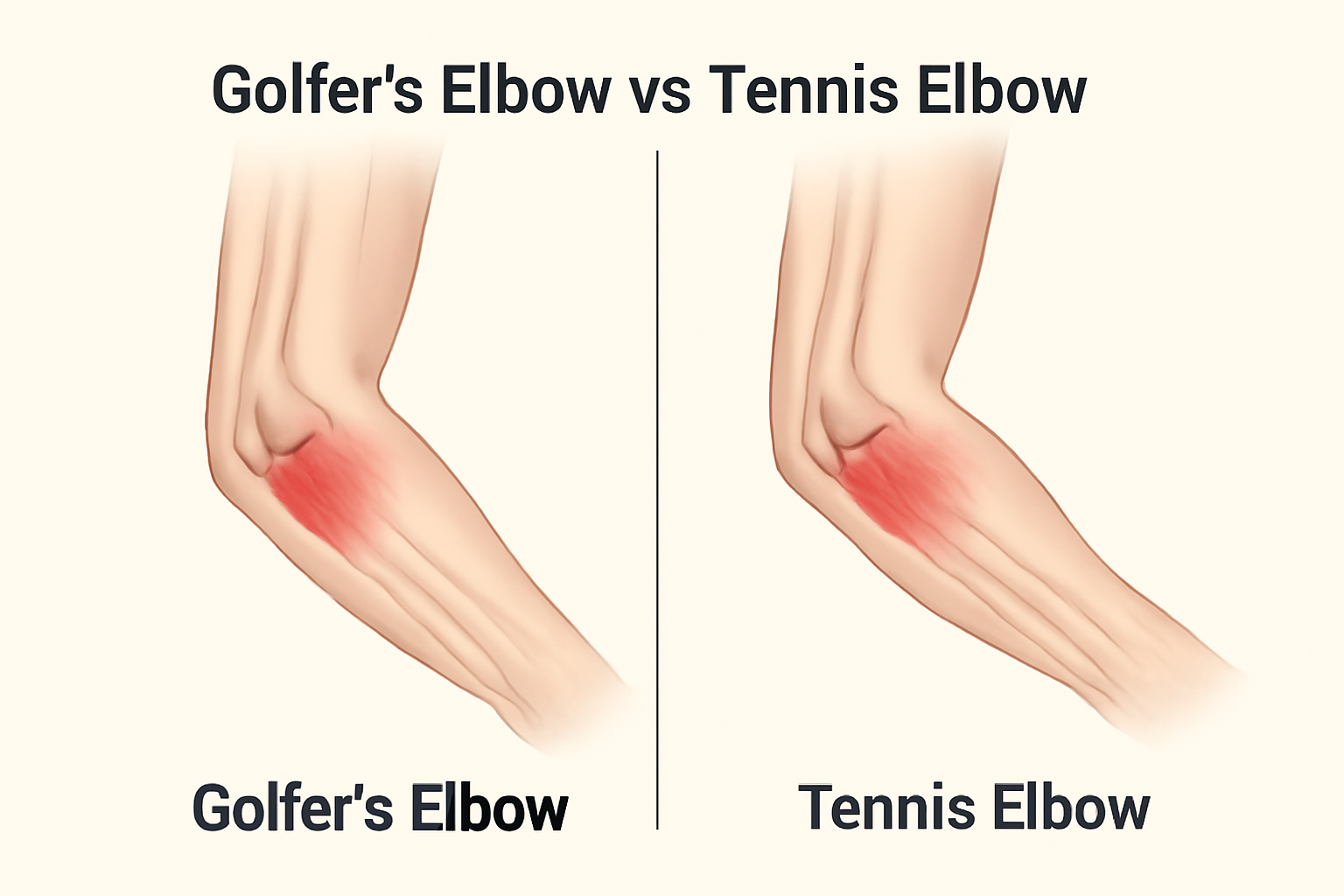
Two common elbow injuries are Golfer’s Elbow vs Tennis Elbow. Despite pain being the common feature in both, they refer to different areas of the elbow and are caused by different things. Overuse of the wrist by repetitive motion is a leading cause for these types of conditions and are found in many athletes, particularly players with racket sports or those who participate in activities that entail consistent gripping actions Discover the key differences between Golfer’s Elbow and Tennis Elbow. Learn about the causes, symptoms, treatments, and prevention tips for these common sports injuries..
In this article, we shall explain the main differences between Golfers Elbow vs Tennis Elbow, causes, symptoms, treatments and prevention tips for both injuries. By paying attention to these two injuries, you’ll become better at recognizing them early, doing the correct things to address them and avoid them in the future.
Table of Contents
What is Golfer’s Elbow?
Golfer’s Elbow is a condition characterized as an overuse injury leading to inflammation and pain on the inner aspect of your elbow. The problem lies in the tendons that connect to this bony bump (medial dicotyledon) on the inner side of the elbow. They control the muscles that dumbbells and allow you to flex your wrist and fingers.
Golfer’s Elbow can strike anyone, but it is especially widespread among golfers, baseball players and weightlifters as well as those whose activities require repetitive gripping or swinging. Although this problem is common among sports enthusiasts it can also occur with those who do manual labor or participate in activities that involve repeatedly bending and turning the wrist.
Symptoms of Golfer’s Elbow:
Medial Elbow Pain Tenderness or pain on the inner side of the elbow (medial epicondyle).
- Pain referring down to the forearm.
- Weakness of the wrist and fingers.
- Gripping objects or making a fist are painful.
- Stiffness in the elbow.
Chronic pain exacerbated by wrist flexion or movements in the forearm.
Causes of Golfer’s Elbow:
Repeated pulling motions, such as the ones involved in golfing, baseball or lifting.
“Overusing” the forearms as a result of improper form or technique.
Aging tendons that become less resistant to strain.
Blunt force to the inside of the elbow.
What is Tennis Elbow?
Lateral Epicondylitis, or Tennis Elbow, is an overuse injury that impacts the tendons on the outside of the elbow. It is specifically the ex tensor tendons that enable wrist extension, and other functions of the forearm. Tennis elbow, as the name indicates, is common in tennis players because of all the backhand swings and other racket-induced stress. But tennis elbow strikes anyone who excessively uses their arms — such as manual laborers or painters, and even office workers doing repetitive movement with a computer mouse or keyboard.
Symptoms of Tennis Elbow:
- Pain and tenderness on the outside of your elbow (lateral epicondyle).
- Pain in the forearm that travails up or down.
- Inability to grip, it is difficult to grasp objects.
- Stretching of the wrist or hand is painful.
- Trouble lifting, grasping or holding something like a cup or bag.
Stiffness in the elbow joint.
Causes of Tennis Elbow:
- Repetitive wrist extension such as is experienced when playing tennis or racquet sports, using a screwdriver on manual labour.
- Salary forearm overuse, extensor muscle of wrist and finger.
- Poor skill in racket sports that place the elbow under stress.
- Degeneration of the tendons with age, so that they are more prone to injury.
Golfer’s Elbow vs Tennis Elbow: What is the Difference?
Both conditions lead to inflamed tendons in the elbow, but how do they differ according to location and when overuse or injury? Here is a difference comparison to clarify the differences:
Golfer’s Elbow
Tennis Elbow
Involves the medial epicondyle (side of the elbow closest to the body).
Affects the outside of the elbow (lateral epicondyle).
Affects the tendons of flexor muscles of the forearm.
Extends tendons of the forearm.
Frequently results from grasping, lifting or swinging.
Commonly occurs with backhand or wrist extension.
Pain is usually centered in the forearm and inner elbow.
The pain is experienced on the outer aspect of the elbow and may spread down the forearm.
Prevalent in golfers, lifters and baseball players.
Frequent in tennis athletes, carpenters, and painters.
Golfer’s Elbow and Tennis Elbow Treatment There are a range of treatments available for golfer’s elbow and tennis elbow.
Both will respond to the same course of treatment but depending on how severe the injury is and the exact area affected etc, there are a few differences in what you do.
Rest and Ice
One of the early treatments for both is resting the elbow and avoiding those activities that make it painful. An ice pack applied to the elbow can help with swelling and inflammation.
Non-Steroidal Anti-Inflammatory Drugs (NSAIDs)
Over-the-counter drugs such as ibuprofen or naproxen can ease pain and inflammation in the affected tendons.
Physical Therapy
Physical therapy has an important role in both entities. A licensed therapist can lead patients through exercises to:
Strengthen the forearm muscles.
Enhance flexibility and increase range of motion.
Fix any bad movement mechanics or technique that caused the injury.
For Golfer’s Elbow: Work on the exercises which will work to strengthen the muscles located on the flexor side of the forearm.
Tennis Elbow: Strengthening of the extensors as well as specific wrist and forearm mechanics work.
Bracing and Strapping
A counterforce brace or an elbow strap may alleviate strain on those tendons when it shifts tension away from the site of injury.
Steroid Injections
An injection of corticosteroids may be advised, if the condition is severe, to relieve inflammation. However, this normally is a last resort if other treatments have not worked.
Surgery
In some cases, surgery is required when conservative management fails. Surgery usually consists of excising the damaged tissue or reattaching the tendon to the bone. GETTING TENNIS ELBOW (more than for Golfer’s Elbow…)
How to avoid Golfer’s elbow vs Tennis Elbow!
However, these conditions can usually be avoided through a combination of strengthening exercises, technique optimization and sufficient rest. Here are a few tips on how to prevent Golfer’s and Tennis Elbows:
Warm Up Stretch: Never have your muscles cold when needing to work them in an repetitive manner such as sports casting. Extend your forearms and wrists for greater flexibility and less stiffness.
Isometric exercises – Work on forearm and wrist muscles to help give some strength support to the elbow joint.
Good Form: To minimize unnecessary stress on the elbow, be sure to use good form when playing a sport like tennis or golf or doing manual labor.
Rest: Let your body recover and heal between activities that stress the elbow.
Wear the right Equipment: Be sure tennis rackets, golf clubs or any sports equipment that you use is fitted properly for your body type and technique.
FAQ
What’s the difference between Golfer’s Elbow vs Tennis Elbow?
Golfer’s Elbow is located on the inner side of the elbow (medial epicondyle) and Tennis Elkow on the outer side (lateral epicondyle).
Can you cure Golfer’s Elbow vs Tennis Elbow without surgery?
Yes, the problem is that both conditions generally respond to conservative treatment — such as rest and physical therapy for the first and anti-inflammatory medication like ibuprofen for the second. Extreme cases may require surgery.
What is the recovery time for Golfer’s Elbow or Tennis Elbow?
Times to recovery vary, but with appropriate intervention most people see improvement within 6 to 12 weeks. It can take longer to make a full recovery if the condition is severe.
Is it safe to be playing sports with Golfer’s Elbow or Tennis Elbow?
It’s probably wise to stay away from activities you know will make the pain worse. If in doubt, ask a health professional when sports can be safely resumed.
What should I do to prevent getting Golfer’s Elbow or tennis elbow?
Avoiding these means having a good warm-up, strength training, good technique and sufficient rest. If you’re doing repetitive motions, be sure to take breaks.
Conclusion
Golfer´s and Tennis Elbows are widespread injuries that lead to pain, restricting the patient’s activities. It is important to recognize the distinguishing features of these conditions in order to make a timely diagnosis and provide appropriate therapy. Though treatment is similar offering rest, physical therapy and medication to manage pain, the two conditions aren’t one in the same and involve different tendons as well as movements that lead to injury.
If you believe that you or your child may have either one, it is important to see a healthcare provider for an accurate diagnosis and appropriate treatment. Most people, with the right approach, are able to make a full recovery and return to normal activities without permanent injury More Post.
Recommended
