
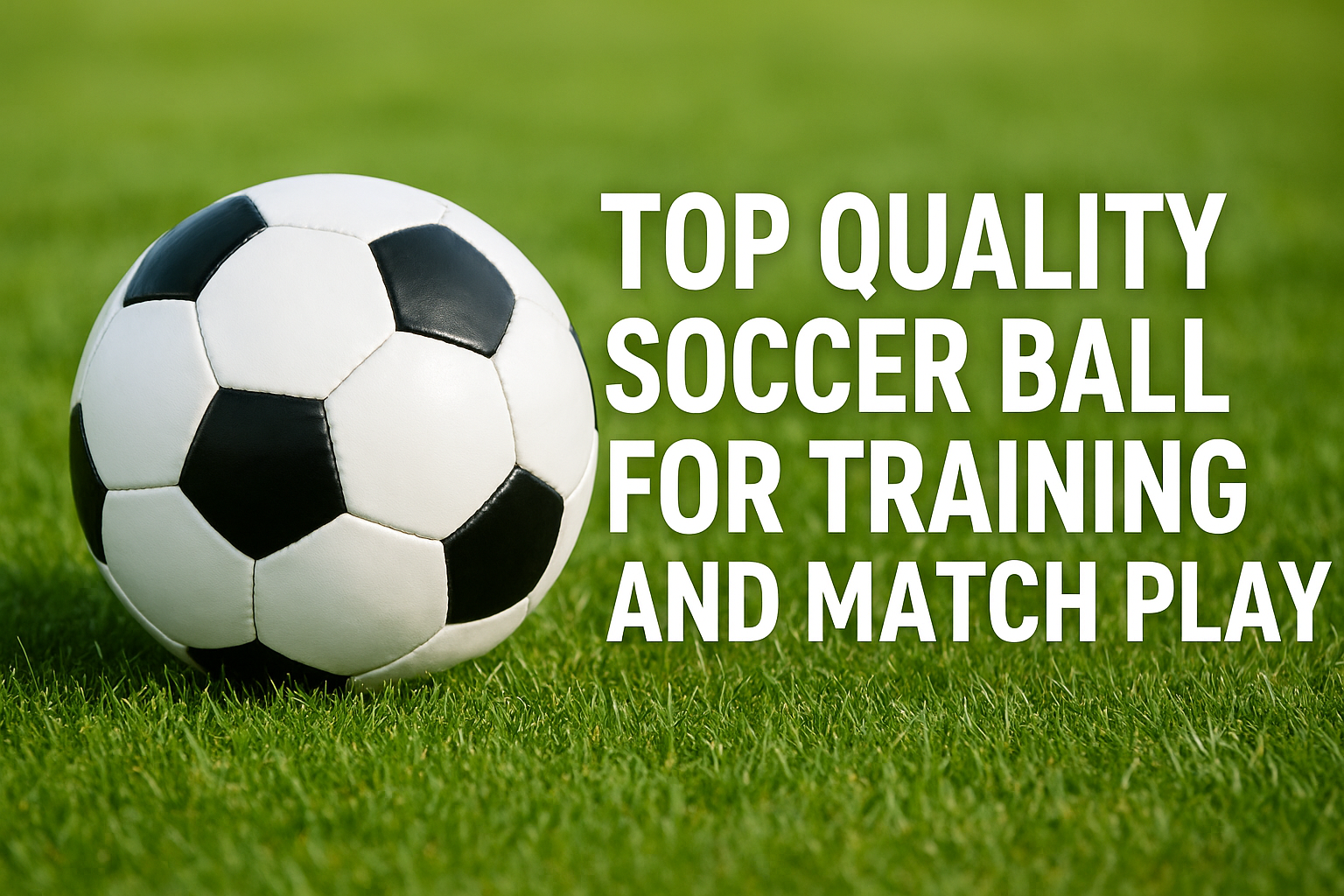

Soccer is the world’s most popular sport, and the soccer ball is at its center. Selecting a top-quality soccer ball for training and match play is crucial for performance and skill development. With millions of soccer balls used globally each year, demand for durable, high-performance balls continues to grow. For example, the U.S. imported 3.5 million soccer balls in 2023, reflecting soccer’s booming popularity. In this guide we’ll cover everything from construction and certifications to sizes and skills, helping you pick the perfect soccer ball for practice and games. Whether you’re looking at official match balls or training soccer balls, our expert tips and linked resources will ensure you make an informed choice.
Features of a High-Quality Soccer Ball
A top-quality soccer ball excels in construction, materials, and design. Key features to look for include:
- Durable Cover Materials: Premium soccer balls use synthetic leather (usually polyurethane, PU) for the outer panels. PU is now the dominant material because of its softness, durability and water resistance. In contrast, cheaper balls often use PVC, which is less flexible. Thermally bonded seams or hand-stitched panels improve roundness and reduce water uptake.
- Panel Design: The classic soccer ball design has 32 panels – 12 black pentagons and 20 white hexagons – arranged in a spherical truncated icosahedron. This geometry is not only iconic (think Telstar, the 1970 World Cup ball) but also optimized for a spherical shape. Some modern match balls even tweak panel shapes for better aerodynamics. Understanding this pattern is helpful even for artists: many tutorials on “how to draw a soccer ball” guide you through sketching one pentagon surrounded by hexagons.
- FIFA Certification: Look for FIFA Quality or FIFA Quality Pro marks. According to industry sources, a FIFA Quality Pro badge means the ball “has undergone the most rigorous testing, focusing on performance, accuracy, durability, and safety”. In top leagues and international play, FIFA-compliant balls are required.
- Construction Details: Match balls often feature thicker foam backing (around 3.0 mm or more) under the cover and a softer latex bladder for optimal touch and flight. Training balls use machine-stitched panels with thinner foam (~2.0 mm) and stiffer bladders to endure heavy use. The bladder material (latex vs butyl) affects air retention; butyl bladders hold pressure longer, meaning less frequent inflation.
- Weight and Balance: Regulation size-5 balls (13+ years) must weigh 410–450 g and measure 68–70 cm in circumference. High-quality balls maintain weight and sphericity well; minor tolerances in weight or roundness can make the ball wobble or bounce unevenly in flight.
These features ensure the ball will feel consistent. As one guide notes, top match balls offer “stable flight, seamless thermally bonded panels, and minimal water uptake,” giving players confidence on every touch.
Soccer Ball Sizes for Youth Players
Choosing the correct size is vital for training and safety. Soccer balls come in sizes 1–5. FIFA guidelines and youth leagues typically recommend:
- Size 1–2 (Skills/Toddler balls): Very small (18–22″), used for very young children (under 5) or skills drills. Size 2 is popular for age 3–5.
- Size 3 (Youth ball, ~23–24″ circ.): Best for ages 6–8. Many under-8 programs use size 3. Some 8-year-olds (especially smaller or beginners) may still use size 3 for better control.
- Size 4 (Junior ball, ~25–26″): Standard for ages 8–12. At age 8, most players transition to size 4 as they develop strength and skill. A size 4 is official for youth leagues up to U12.
- Size 5 (Adult ball, 27–28″): Official match ball for 13 and up. Anyone older than 12 typically uses size 5 for training and games.
According to The Soccer Factory, “Size 4 is suitable for ages 8–12, while Size 3 is recommended for kids younger than that”. Similarly, FIFA and many leagues say size 4 for 8- to 12-year-olds, and size 3 for under-8s. Always check your specific league rules, but a simple rule of thumb: at age 8+ lean size 4; under 8 use size 3.
Training vs. Match Balls: What’s the Difference?
Soccer training drill – players perform repetitive ball touches to hone skills (image: U.S. Navy trainer with Ghanaian kids)
Training balls and match balls may look similar, but they serve different purposes. Training soccer balls are built for durability and everyday practice. They typically feature machine-stitched panels and a tougher cover with thinner foam (around 2 mm) to withstand thousands of kicks, headers, and dribbles. The emphasis is on long wear; as one source puts it, training balls are made “to stand up to heavy use with thousands and millions of touches over months and years”. They also cost less (often $20–$80) because performance is slightly sacrificed for toughness.
Match (official) balls, on the other hand, prioritize performance over longevity. These balls use higher-end materials and construction: usually hand-stitched or thermally bonded panels, a thicker foam backing (3.0 mm+), and a softer bladder for optimal touch. The result is superior feel, accurate flight, and consistent bounce – important for competitive play. However, match balls are not designed for daily hard-practice; they tend to wear out faster under intense use. In official games, leagues often require certified match balls. For example, NCAA and NFHS rules mandate “approved” match balls to ensure uniformity. These high-grade match balls carry FIFA Quality or Quality Pro ratings and cost $150–$200+.
Summary of differences:
– Durability: Training balls = very durable; Match balls = less so (not built for abuse).
– Construction: Training (machine-stitched, thin foam ~2 mm); Match (hand-stitched or bonded, thick foam ~3+ mm).
– Feel & Flight: Match balls offer premium touch and stable flight; training balls are harder and stiffer.
– Cost: Training balls are budget-friendly; match balls are pricier due to high-end specs.
Choosing between them depends on use: use training balls for daily practice and skill work. Reserve an official match ball for actual games or to simulate match conditions in scrimmages. Some coaches even recommend training with a good match-quality ball occasionally, so players get used to the feel, but remember the higher cost and shorter lifespan of match balls in practice.
Soccer Ball Materials & Care
Quality soccer balls use advanced materials to balance softness, durability, and weather resistance. Polyurethane (PU) covers dominate the market today. PU provides a soft touch (helpful for ball control) and resists scuffs and moisture. In fact, industry reports confirm that “PU has become the dominant material as it provides ideal properties including softness and durability and water resistance”. PVC is found on cheaper balls (it’s more rigid and less expensive), while TPU is used on premium balls for durability. The inner bladder is usually latex (for elite balls, giving great rebound but slower deflation) or butyl (for training balls, holding air much longer).
Proper care extends your ball’s life. Inflate to the correct pressure: a size 5 ball is typically 8.7–16.0 psi at sea level. Over-inflating can make a ball too hard and risk seams splitting, while under-inflating causes poor play. Clean your ball after use (wipe off mud and grass) and store it out of extreme heat or dampness. Check for damage: peeling foam, loose panels, or leaks mean it’s time for a new ball. As networldsports explains, inferior balls that haven’t passed quality testing might “lose shape after a strong impact” and fly unpredictably. So sticking to known brands or FIFA-approved balls also helps ensure longevity.
Soccer Ball Design & Clipart
A vector-style soccer ball (classic pentagon/hexagon design)
The classic black-and-white soccer ball design is one of the most recognizable symbols in sports. It’s based on a truncated icosahedron – a sphere made of 12 pentagons and 20 hexagons. This became famous with the 1970 Adidas Telstar ball (World Cup) and is still used today. Many soccer ball drawings and clipart reproduce this pattern. For example, a common art lesson is “how to draw a soccer ball”: one method is to sketch one pentagon in a circle and then draw hexagons around it. Even vector clipart (like the image above) highlights these geometric shapes.
Although real match balls now come in many colors and panel styles, the traditional pattern remains iconic. Understanding this design is also useful for customizing or branding a ball: many logos are applied to one of the pentagonal panels.
Training with Your Soccer Ball: Kicking and Juggling
Mastering ball skills goes hand-in-hand with using a good ball. Proper technique often starts with good equipment. Here are some basic drills and tips:
How to Kick a Soccer Ball
Whether passing or shooting, kicking a soccer ball correctly is fundamental. Key points include:
– Eye on the Ball: Keep your gaze on the point of contact on the ball for maximum accuracy. Looking at the goal instead can reduce power and precision.
– Foot Placement: Plant your non-kicking foot beside the ball, pointing toward your target. This alignment steers the ball in the desired direction.
– Ankle Position: Lock your ankle on the kicking foot to form a firm striking surface. Ankle stability greatly increases the power of the kick.
– Part of Foot: For a standard powerful shot, strike with the laces (instep) – roughly the area around the knuckle of your big toe. For a curled or lifted shot (like a chip), you might use the toe or outside of the foot differently.
– Body and Arm Movement: Lean your body slightly into the kick and use your arms to balance. Proper body angle can help control the ball’s flight.
Coaches often teach these fundamentals through drills. For example, drills focusing on “first touch” prepare you for a strong kick. Practicing with a high-quality ball ensures that these touches translate well in games.
How to Juggle a Soccer Ball
Juggling (kicking the ball repeatedly into the air without letting it hit the ground) is a great drill for ball control and first touch. Benefits of juggling include improved touch with both feet, better awareness, and confidence handling the ball. To get started:
– Basic Juggle Drill: Hold the ball in your hands and drop it onto your right foot. With your ankle locked and toes pointed up, use the laces of your foot to tap the ball straight up. Then let it drop and repeat, alternating feet each time. Keep the height around knee or waist level for control.
– Footwork: Once you can get 5–10 touches with one foot, switch to alternating feet: right-left-right-left. The Adidas tutorial notes that beginners should keep touches “below your waist” and lift from the knee to maintain control.
– Consistency Over Power: Focus on gentle, controlled touches rather than trying to kick the ball hard. Controlling the ball’s height (low and steady) is key.
– Warm-Up: Before juggling, warm up ankles and knees (e.g. ankle circles, gentle toe-taps) to prevent injury and help control.
– Use the Right Ball: A well-inflated training ball is recommended for practice. Training balls have thicker linings and stitching to handle repetitive taps, and they rebound in a forgiving way. Keeping the ball at correct pressure also helps make the bounce predictable.
With regular practice of juggling and kicking drills, players of all levels can improve their ball skills. As Adidas notes, juggling “improves your first touch, ball control, and footwork with both feet,” giving players an edge in games.
Frequently Asked Questions
Q: What size soccer ball should an 8-year-old use?
A: Most youth leagues recommend a Size 4 soccer ball (25–26″ circumference) for ages 8–12. At age 8, many children are ready for Size 4, as it helps them develop proper technique. In some cases (for beginners or smaller kids), a Size 3 ball (23–24″) may be used to make practice easier. Always check your league’s rules, but the general guideline is Size 4 for 8-year-olds.
Q: How do I kick a soccer ball properly?
A: Focus on technique: keep your eyes on the ball at impact for accuracy, plant your non-kicking foot pointing toward the target, and strike the ball with your laces (instep) for power. Lock your ankle during the kick to stabilize the foot. Use a quality ball at the correct inflation (8.7–16 psi for size 5) so you get realistic feedback when practicing. Proper form and repetition are key to mastering a strong, accurate kick.
Q: How do I juggle a soccer ball?
A: Start by dropping the ball to your foot and tapping it gently back up with the laces (keeping your ankle locked and toes up). Aim to keep the ball around knee height. Alternate feet gradually: e.g., right foot, then left foot, then right-left-right, and so on. Use a well-inflated training ball for practice. Control is more important than power; as you improve, try using thighs and then the head. Consistent juggling practice builds first touch and ball control.
Q: How do I draw a soccer ball?
A: To draw a soccer ball, sketch a circle and then add its panel pattern. The traditional design has 12 pentagons (often colored black) and 20 hexagons (white), like a truncated tetrahedron. A common method is to draw one central pentagon, then surround it with hexagons, continuing outward. Many tutorials and clipart simplify this shape to help beginners. This iconic pattern was popularized by Adidas’ Telstar in 1970. Using a ruler or software can help make the panels symmetric if needed.
Q: What’s the difference between a training soccer ball and a match soccer ball?
A: Training balls are made for durability and everyday use. They are usually machine-stitched with a thinner foam layer (~2 mm) and stiffer bladders so they can withstand heavy practice. Match balls are built for peak performance: they often have hand-stitched panels, thicker foam backing (3 mm or more) and a softer bladder for touch. As a result, match balls fly truer and feel softer on the foot, but they won’t last as long under rough play. Official matches usually require a FIFA-approved match ball for consistency. In short: training balls = tough and long-lasting; match balls = premium feel and accuracy.
Q: What does FIFA Quality Pro mean for a soccer ball?
A: A FIFA Quality Pro mark is the highest certification for a soccer ball. It means the ball passed rigorous FIFA tests for weight, roundness, water absorption, retention, and more. Only balls meeting these strict criteria are used in professional tournaments. In practical terms, it guarantees a very consistent, high-performance ball.
Q: How do I care for my soccer ball?
A: Keep the ball properly inflated (size 5: ~8.7–16 psi). Use a pump with a gauge to avoid overinflation. After playing, clean off dirt and grass, then dry the ball before storage. Store it at room temperature away from direct sunlight or moisture. Check the ball regularly: if seams are splitting or the cover is peeling, replace it. Training balls can last for thousands of touches, but match balls may need replacement sooner if used heavily.
Q: Are official match soccer balls worth the cost?
A: Official match balls (FIFA Quality Pro) are expensive (often $150–$200+) because they use the best materials and tight manufacturing tolerances. They offer premium feel, stable flight, and consistent bounce. For casual play, a cheaper replica is fine, but serious players often find that the enhanced touch and accuracy of a match ball justify the investment.
Q: Where can I buy an authentic high-quality soccer ball?
A: Look for reputable soccer retailers and brands (Adidas, Nike, PUMA, etc.) that clearly state FIFA certifications. For example, The Soccer Factory (a specialist retailer) highlights balls’ official certifications and league uses. Buying from official sources or well-known sports stores ensures you get a genuine product. Avoid very cheap “generic” balls without any quality mark, as these often lack consistent performance.
Final Thoughts
Choosing the right soccer ball is more than a purchase—it’s a step toward better play. A top-quality ball matched to your skill level and field conditions can make training safer, more effective, and more fun. Whether you’re teaching a child to juggle or training for a match, prioritize a ball with the right size, material, and certification. Remember to maintain your ball and replace it when worn More Post.
Ready to elevate your game? Invest in a well-made soccer ball and apply these tips on kicking, juggling, and care. Share this guide on social media or comment below with your favorite soccer ball experiences. Your input helps others find the perfect ball too—after all, the world’s best goals start with the right soccer ball.
